
Travis Tritt - Tougher Than The Rest!
First Published in Country Music International – January 1999
Ten years after shaking Music City with his abrasive mix of southern rock, stone-cold honky-tonk and r&b, TRAVIS TRITT is back with a new album that is poised on the cutting-edge of new technology. But have his marriage and the birth of his daughter last year finally caused the Nashville Outlaw to slow down? “You can still have long hair and do rock’n’roll,” he tells Alan Cackett, “but you can also be a good husband and father and spend time with your family.”
“The outlaw image that I have been given over the years is based on the fact that I always speak my mind,” says Music City Maverick Travis Tritt. “I've never been politically correct about anything, I've always tried to say what I was thinking and tell people the truth. As a result of that I've been labelled an outlaw character.”
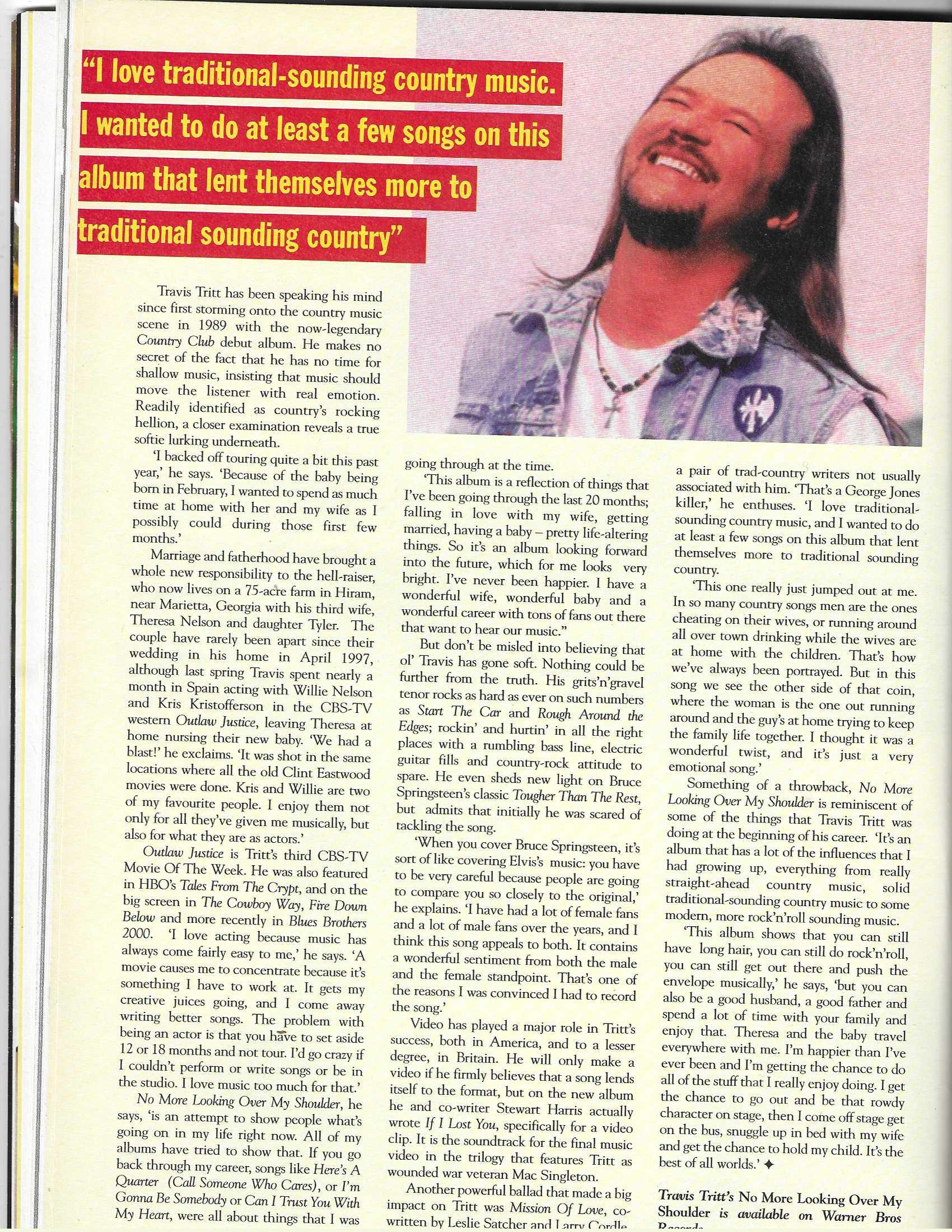
With a repertoire that has melded outlaw, southern rock, stone-cold honky-tonk and rhythm and blues into a distinctive sound totally his own, Travis Tritt has emerged as the archetypal 1990s country pioneer. A wild child who hangs out with rockers like Dave Lee Roth of Van Halen and Gary Rossington of Lynyrd Skynyrd, decked out in leather and fringed jackets, long, straight hair tumbling over his shoulders, he looks a pretty mean hombre when lined up against the clean-cut, cowboys of today.
The modern-day Nashville outlaw was holed up in a New York hotel room when I caught up with him, preparing for the triple format launch of his latest album, NO MORE LOOKING OVER MY SHOULDER, on DVD as part of spearheading his music into the 21st century. He will be the first country artist to have his music available on the new system, placing him in the vanguard of the new home electronic hardware.
The DVD-ROM will carry Tritt’s trilogy of music videos dealing with his wheelchair bound Vietnam vet character Mac Singleton, Anymore, Tell Me I Was Dreaming and the concluding new video, If I Lost You, also the first single from NO MORE LOOKING OVER MY SHOULDER. Also included are behind-the-scenes footage from the third clip's shoot, lyrics from the new album and Tritt's complete discography.
Though Tritt acknowledges the risk of new technology reducing human beings to couch potatoes, he believes that the excitement of a good live show should have the magic to pull people out of their living room.
“Great music is always going to be a one-to-one situation between entertainer and audience,” he insists. “It's still going to be bred in those honky-tonks where I started out. It will never be replaced by computers or home entertainment. The clubs will always be there.”
He should know: Tritt climbed to his current stature as a country superstar the hard way. He spent years playing clubs, honky-tonks and dives, perfecting his craft as a bona fide entertainer. A couple of years ago, he took a break from playing thr big arenas, and returned to his roots on the honky-tonk circuit with surprise appearances at small clubs in San Antonio, Fort Worth, Amarillo and Lubbock, Texas. He said at the time that he just wanted to get back to the core audiences that he first played for. “When you get into arenas with 8,000-10,000 people, it's a lot of fun, but there's no one-on-one connection.”
Though he has never really been embraced by the Nashville music community, he has built up a massive fan following, reflected in a record haul that includes one gold, one platinum, four double-platinums and one triple platinum. He has also earned a Grammy, four CMA awards and membership of the Grand Ole Opry. Yet many establishment figures fight shy of him.
“Just because I say what I think, some people interpret that as: ‘"Oh jeez, he must go out and get drunk and beat people up for fun.’ That's never been a part of my character, but some people read that into it.”

Travis Tritt has been speaking his mind since first storming onto the country music scene in 1989 with the now-legendary COUNTRY CLUB debut album. He makes no secret of the fact that he has no time for shallow music, insisting that music should move the listener with real emotion. Readily identified as country's rocking hellion, a closer examination reveals a true softie lurking underneath.
“I backed off touring quite a bit this past year,” he says. “Because of the baby being born in February, I wanted to spend as much time at home with her and my wife as I possibly could during those first few months,”
Marriage and fatherhood have brought a whole new responsibility to the hell-raiser, who now lives on a 75-acre farm in Hiram, near Marietta, Georgia with his third wife, Theresa Nelson and daughter Tyler. The couple have rarely been apart since their wedding in his home in April 1997, although last spring Travis spent nearly a month in Spain acting with Willie Nelson and Kris Kristofferson in the CBS-TV western Outlaw Justice, leaving Theresa at home nursing the new baby. “We had a blast!” he exclaims. “It was shot in the same locations where all the old Clint Eastwood movies were done. Kris and Willie are two of my favourite people. I enjoy them not only for all they've given me musically, but also for what they are as actors.”
Outlaw Justice is Tritt’s third CBS-TV Movie Of The Week. He was also featured in HBO's Tales From The Crypt, and on the big screen in The Cowboy Way, Fire Down Below and more recently in Blues Brothers 2000. “I love acting because music has always come fairly easy to me,” he says. “A movie causes me to concentrate because it's something I have to work at. It gets my creative juices going, and I come away writing better songs. The problem with being an actor is that you have to set aside 12 or 19 months and not tour. I'd go crazy if I couldn't perform or write songs or be in the studio. I love music too much for that.”
NO MORE LOOKING OVER MY SHOULDER, he says, “is an attempt to show people what's going on in my life right now. All of my albums have tried to show that. If you go back through my career, songs like Here's A Quarter (Call Someone Who Cares),or I'm Gonna Be Somebody or Can I Trust You With My Heart, were all about things that I was going through at the time.”
“This album is a reflection of things that I've been going through the last 20 months; falling in love with my wife, getting married, having a baby—pretty life-altering things. So it's an album looking forward into the future, which for me looks very bright. I've never been happier. I have a wonderful wife, wonderful baby and a wonderful career with tons of fans out there that want to hear our music.”
But don't be misled into believing that ol' Travis has gone soft. Nothing could be further from the truth. His grits'n'gravel tenor rocks as hard as ever on such numbers as Start The Car and Rough Around the Edges; rockin' and hurtin' in all the right places with a rumbling bass line, electric guitar fills and country-rock attitude to spare. He even sheds new light on Bruce Springsteen's classic Tougher Than The Rest, but admits that initially he was scared of tackling the song.
“When you cover Bruce Springsteen, it's sort of like covering Elvis’ music: you have to be very careful because people are going to compare you so closely to the original,” he explains. “I have had a lot of female fans and a lot of male fans over the years, and I think this song appeals to both. It contains a wonderful sentiment from both the male and the female standpoint. That's one of the reasons I was convinced I had to record the song.”
Video has played a major role in Tritt's success, both in America, and to a lesser degree, in Britain. He will only make a video if he firmly believes that a song lends itself to the format, but on the new album he and co-writer Stewart Harris actually wrote If I Lost You, specifically for a video clip. It is the soundtrack for the final music video in the trilogy that features Tritt as wounded war veteran Mac Singleton.
Another powerful ballad that made a big impact on Tritt was Mission Of Love, co-written by Leslie Satcher and Larry Cordle, a pair of trad-country writers not usually associated with him. “That's a George Jones killer,” he enthuses. “I love traditional sounding country music, and I wanted to do at least a few songs on this album that lent themselves more to traditional sounding country.”
“This one really just jumper out at me. In so many country songs men are the ones cheating on their wives, or running around all over town drinking while the wives are at home with the children. That's how we've always been portrayed. But in this song we see the other side of that coin, where the woman is the one out running around and the guy's at home trying to keep the family life together. I thought it was a wonderful twist, and it's just a very emotional song.”
Something of a throwback, NO MORE LOOKING OVER MY SHOULDER is reminiscent of some of the things that Travis Tritt was doing at the beginning of his career. “It's an album that has a lot of the influences that I had growing up, everything from really straight-ahead country music, solid traditional-sounding country music to some modern, more rock'n'roll sounding music.”
“This album shows that you can still have long hair, you can still get out there and push the envelope musically,” he says, “but you can also be a good husband, a good father and spend a lot of time with your family and enjoy that. Theresa and the baby travel everywhere with me. I'm happier than I've ever been and I'm getting the chance to do all of the stuff that I really enjoy doing. I get the chance to go out and be that rowdy character on stage, then I come off stage get on the bus, snuggle up in bed with my wife and get the chance to hold my child. It's the best of all worlds.”