
Mark Nesler - The Nashville Cats
First Published in Country Music International – December 1998

Having scored his first success as a songwriter in 1985, Texan scribe MARK NESLER had another thirteen years of writing hits for other people before finally signing a record deal earlier this year.
Texan songwriter Mark Nesler has had cuts by such platinum artists as Tracy Byrd, Mark Chesnutt, Tim McGraw and Trace Adkins, as well as Rhett Akins, Aaron Tippin, Lee Greenwood, Ed Bruce and Tammy Wynette. One of the most mature writers on Music Row, he is a late bloomer, who has come into his own as a writer in his mid-30s and signed his first record deal earlier this year, at 37-years-old, with Asylum Records. Making his recording debut at such an age is a fact he not only doesn't want to hide, but of which he is proud. “I don't want people to perceive me as someone who hasn't been around the block,” he says.
Working with acclaimed producers Jerry Crutchfield and Kyle Lehning, Nesler has pulled together a wide-ranging collection of slice-of-life ballads and a couple of rockers for his recently released album I'M JUST THAT WAY. It's a soundtrack of real life, coming not from a wide-eyed innocent, but from a savvy observer of the human condition. Someone who has felt his share of life's hurt, but who has also learned time's healing power.
“It's a very artistic album,” Nesler states. “I wasn't thinking about style or direction—the only rule was putting great songs on the album. Maybe there should have been a more defined line as far as who I am as an artist, but at the same time, I'm first and foremost a songwriter. I'm not going to sing the same way on every song, because each song comes from a different place. I was hoping that maybe that would be my trademark. To become known as an artist that painted an album that had a lot of different things to offer.”
Quiet, thoughtful and pensive, Nesler is no run-of-the-mill hat act. With his dark, brooding good looks, he comes across as a real, adult man, a modern country singer with maturity, who came to the party ready to dance. He grew up in Buna, Texas, near Beaumont, an area that spawned such talent as Tracy Byrd and Bob McDill. His first taste of success as a songwriter came in 1985 when Ed Bruce took If It Ain't Love into the country Top Ten.
“That was my first cut as a songwriter,” he recalls. “That was many moons ago. I was so excited when I got that cut. It was like a signal from up above to keep on keeping on, and I needed it. It came along at the right time. I met up with Ed about a month after the song came out, in a little Texas town called Columbus.”
For the young aspiring singer and budding songwriter that was some big deal.
He had grown up in a family musical environment, listening to classic country recordings by Marty Robbins, Jimmy Dean, Porter Wagoner, Merle Haggard, and Ed Bruce. His father, a Kentucky native, played guitar and bass, sang and wrote songs and even made an independent record. His mother, Charlsie, also sang and played guitar. Throughout his teens Mark had been making music on a semi-professional basis and by his early 20s had become a full-time musician with something of a local reputation. The meeting with Ed Bruce almost led to Mark missing one of his club dates, as they drank Buds and talked music.
“It was a pretty exciting day for me,” he remembers. “I was a big Ed Bruce fan. I told him I loved his music, his songwriting and everything. I said: ‘You're such a great writer, it really flatters me that you would take the time to cut one of my songs.’ He simply replied by saying: ‘Well, it was a great song.’ So I just kind of smiled and thought: ‘Thank you.’”
“Anyway, I was due to play the grand opening of a club in Beaumont, that was actually an old club they were reopening, called Yvonne's. Historically, Elvis Presley and Hank Willaims Sr had played there, so it was a very nostalgic club. After our meeting I was running late, so I had to speed at 90 miles an hour to get back to Beaumont. I got there about five minutes to nine, ran into the club, popped my guitar out of the case and didn't miss a lick!”
As well as playing club dates, Nesler continued with his writing, and gained further cuts by Tammy Wynette, Lee Greenwood and David Frizzell, but not being based in Nashville was something of a handicap for a country songwriter. He built a little studio at his house so that he could demo his songs, and occasionally worked with other local acts. One of these was the young Tracy Byrd.
“I met Tracy in the mid-1980s,” he recalls. “His manager called me one day and said: ‘I've got this kid who sings pretty good, looks good and I'd like to come over to your house and have you record some work tapes on him.’ Tracy had learned some of my songs, so we recorded five of them. I mixed a little tape and that was really the first time that Tracy Byrd had even heard what he sounded like in a studio.”
At the time, Byrd didn't even have a band—he was virtually just getting started in the business—and for several years he used that work tape in an effort to land a record deal. Over the years Mark and Tracy kept in contact, either bumping into each other on the road or dropping in at each other's club dates. By the early 1990s Mark had put together his own band and was working a hectic schedule of club dates all across Texas, Louisiana and New Mexico.
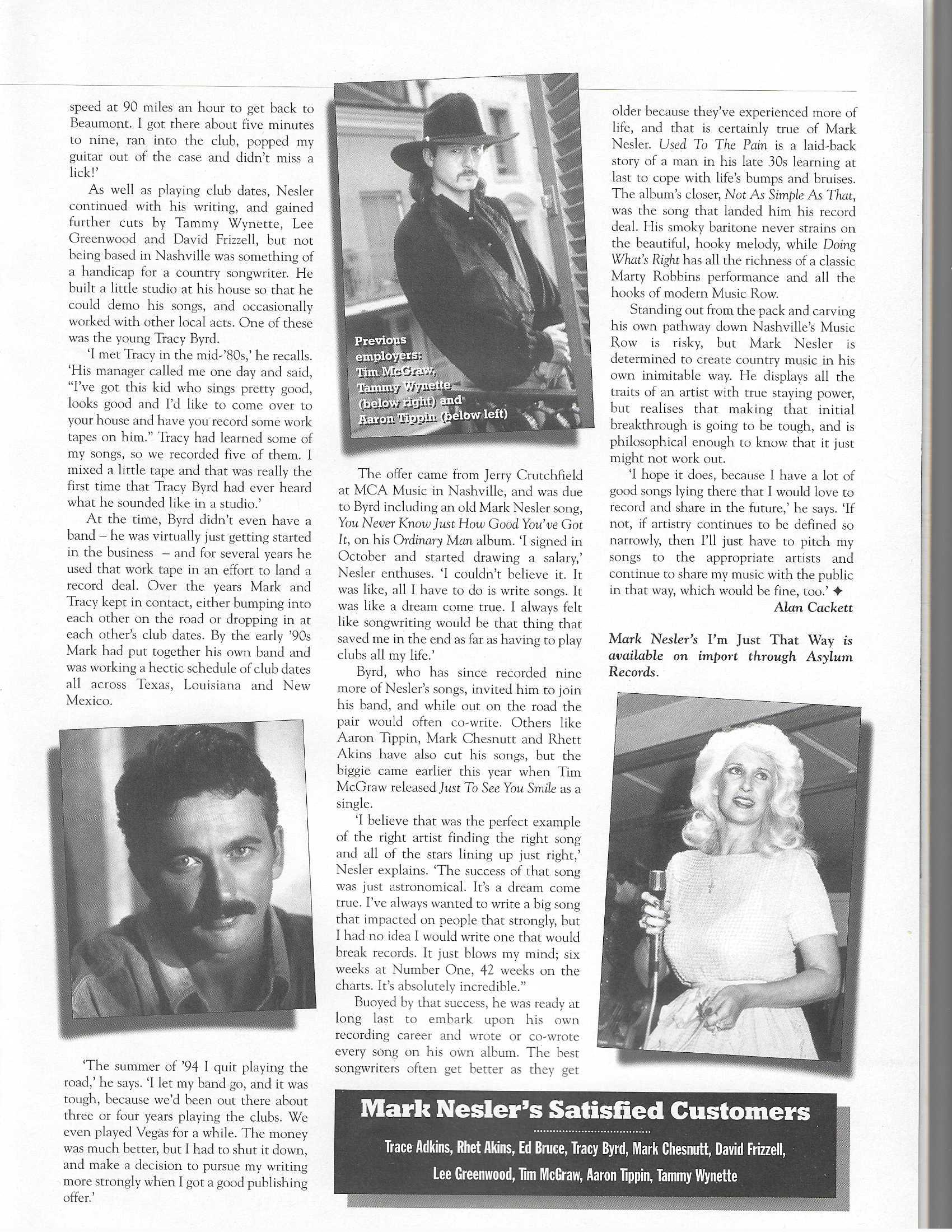
“The summer of ’94 I quit playing the road,” he says. “I let my band go, and it was tough, because we'd been out there about three or four years playing the clubs. We even played Vegas for a while. The money was much better, but I had to shut it down, and make a decision to pursue my writing more strongly when I got a good publishing offer.”
The offer came from Jerry Crutchfield at MCA Music in Nashville, and was due to Byrd including an old Mark Nesler song, You Never Know Just How Good You've Got It, on his ORDINARY MAN album. “I signed in October and started drawing a salary,” Nesler enthuses. “I couldn't believe it. It was like, all I have to do is write songs. It was like a dream come true. I always felt like songwriting would be that thing that saved me in the end as far as having to play clubs all my life.”
Byrd, who has since recorded nine more of Nesler's songs, invited him to join his band, and while out on the road the pair would often co-write. Others like Aaron Tippin, Mark Chesnutt and Rhett Akins have also cut his songs, but the biggie came earlier this year when Tim McGraw released Just To See You Smile as a single.
“I believe that was the perfect example of the right artist finding the right song and all of the stars lining up just right” Nesler explains. “The success of that song was just astronomical. It's a dream come true. I've always wanted to write a big song that impacted on people that strongly, but I had no idea I would write one that would break records. It just blows my mind; six weeks at Number One, 42 weeks on the charts. It's absolutely incredible.”
Buoyed by that success, he was ready at long last to embark upon his own recording career and wrote or co-wrote every song on his own album. The best songwriters often get better as they get older because they've experienced more of life, and that is certainly true of Mark Nesler. Used To The Pain is a laid-back story of a man in his late 30s learning at last to cope with life's bumps and bruises. The album's closer, Not As Simple As That, was the song that landed him his record deal. His smoky baritone never strains on the beautiful, hooky melody, while Doing What's Right has all the richness of a classic Marty Robbins performance and all the hooks of modern Music Row.
Standing out from the pack and carving his own pathway down Nashville's Music Row is risky, but Mark Nesler is determined to create country music in his own inimitable way. He displays all the traits of an artist with true staying power, but realises that making that initial breakthrough is going to be tough, and is philosophical enough to know that it just might not work out.
“I hope it does, because I have a lot of good songs lying there that I would love to record and share in the future,” he says. “If not, if artistry continues to be defined so narrowly, then I'll just have to pitch my songs to the appropriate artists and continue to share my music with the public in that way, which would be fine, too.”